AI AutomationNo. 30
Obsidian as memory for AI agents: how my agents share one brain
My agents don't start from zero each morning. They read from and write to one folder of plain Markdown notes. Here is how it is organised, how a note gets found, and what I got wrong.

The short answer
- My agents share one memory: an Obsidian vault of about 190 plain Markdown notes, sorted into folders by purpose.
- Agents never get the whole vault. Each run gets the handful of notes that match the job, and only the part of each note that answers it.
- One short note is read on every run regardless of topic: whose business this is, the voice, and what must never be done.
- A link written inside a note connects it. A 'related' field in the header alone left notes disconnected, and I only noticed because a test checked.
Want this built and running in your business? See AI automation
Obsidian memory for AI agents is the simplest shared memory I know, and it is what my own agents use. Every agent in my system reads from and writes to one Obsidian vault: a folder of about 190 plain Markdown notes about my business, my clients, my research and what the agents have done. When an agent starts a job, it already knows the context instead of being told again.
This is how that memory is organised, how an agent finds the right note, and the mistake that quietly disconnected half of what the agents wrote. If you want a memory like this behind your own work, book a call.
Why do AI agents need shared memory?
Because without it, every chat starts from zero. You explain the business, paste the prices, describe the tone, and next week you do it again. Worse, the agent that researched something on Monday has no idea what the agent writing on Tuesday needs from it.
A shared memory fixes both. It is the part of an AI operating system that compounds: the longer it runs, the less anyone has to repeat. The AI operating system guide explains where it sits next to the other parts.
Why Obsidian?
Because an Obsidian vault is just a folder of Markdown files. There is no database to export from and nothing locked inside an app. Any agent that can read a file can read the memory, and I can open the same notes in Obsidian, edit them by hand and see how they connect.
That last part matters more than it sounds. A memory you can read is a memory you can correct. When an agent saves something wrong, I open the note and fix it.
What is in the vault?
About 190 notes as of 19 October 2026, in folders by purpose. The biggest ones:
| Folder | Notes | What lives there |
|---|---|---|
| Journal | 59 | What happened each day, written as it happened |
| Research | 19 | Briefs and findings worth keeping |
| SEO | 16 | Keyword research and what each article was for |
| Oracle | 15 | The daily news an agent collects and sorts |
| Memory | 14 | Things the agents were asked to remember |
| Astros | 14 | Notes on what competitors are publishing |
| Projects | 8 | One note per project and what shipped |
| Business Context | 2 | The offer, the prices and the voice |
Small folders can matter most. Per note, the two business-context notes turned up in agents’ runs about nine times as often as a journal entry did.
How does an agent find the right note?
It never gets the whole vault. Pasting everything into every prompt would be slow, expensive and confusing. Instead, each run goes through three steps:
- One note is always read. A short note about whose business this is, the voice, and what must never be done. It is not searched for, because an agent would never think to search for it. It is read on every run, so it has to stay short.
- The notes that match the job are scored. A note scores on how many different words of the job it matches, with each signal capped, so a long rambling note cannot outrank a short precise one. The top few are attached to the run.
- Only the part that answers is quoted. A winning note is split on its headings and only the matching section is handed over. For a long note, the opening paragraph is almost never where the answer is.
Every run records which notes it used and why each one was chosen. Over the same five weeks as my failure study, 618 runs were handed notes from the vault, in 1,615 separate lookups. Another 577 searches found nothing relevant, and the agent was told so instead of being handed something loosely related. When an answer is wrong, I can see whether the agent had the wrong note or the right note and misread it. Those need different fixes.
How do agents write back?
Agents can save notes as well as read them: research findings, things I asked them to remember, and a daily log of what each agent did. A note saved on Monday is in the scoring on Tuesday.
Agents from outside the system can use it too. Hermes Agent, which runs on its own, reads the same vault and saves new notes into its own folder through a small connector. So what Hermes learns is there the next time any of my other agents needs it.
What went wrong?
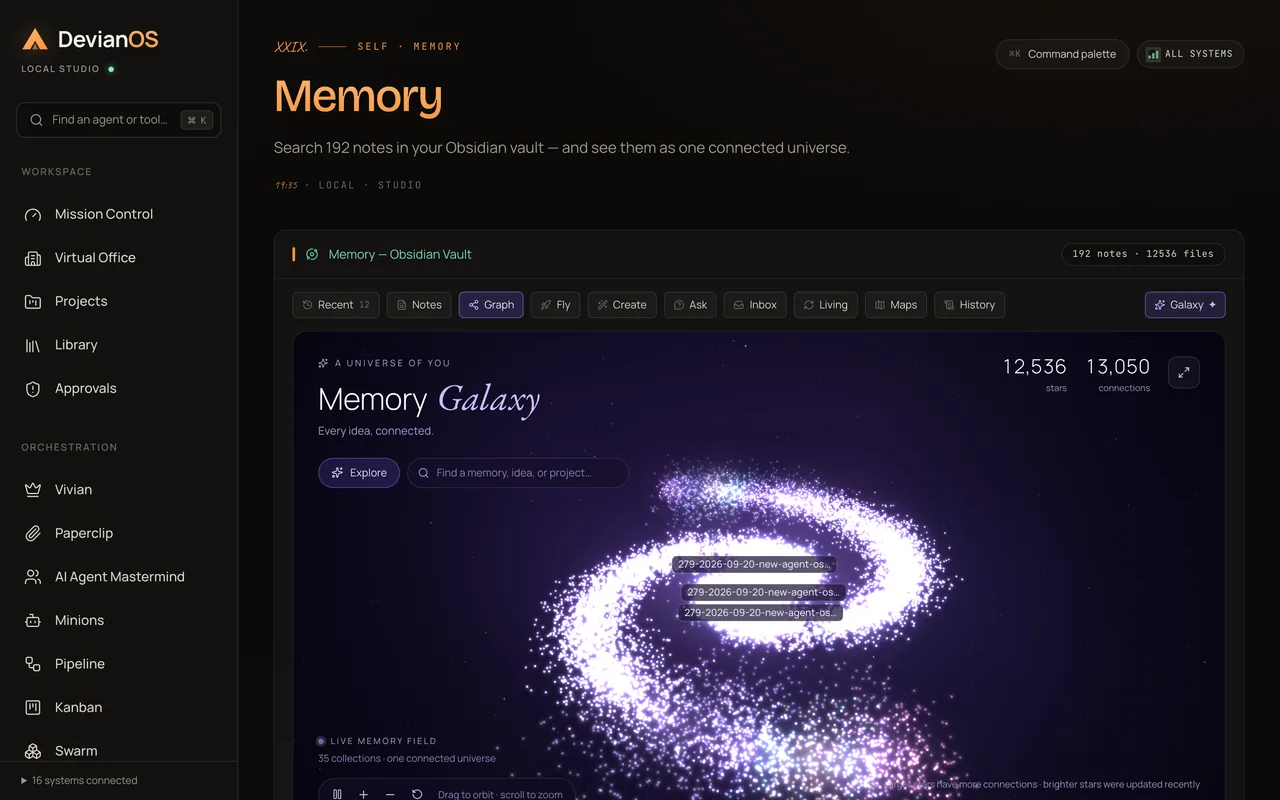
The mistake worth sharing is a quiet one. For a while, when an agent saved a note that was related to other notes, it wrote the relation into the note’s header as a “related” field. It looked right. The header listed the related notes. But the memory only connects notes through links written in the text itself, so every one of those notes was an orphan: connected to nothing, however many relations it claimed.
Nothing errored. The galaxy view looked plausible, because an unconnected note looks exactly like a note that genuinely has no relations. It surfaced only because a test checked that a new note actually linked to its neighbour. The fix was to write the related notes as links in the body of the note.
The general lesson: when something should appear connected, check the connection exists, not just that the field was filled in.
The other thing that goes wrong is noise. A memory that saves everything gets worse, not better, because the useful notes have more to compete with. Folders by purpose, short notes and a person who prunes now and then keep it useful.
How do you set this up for a small business?
You don’t need my whole system to get most of the benefit of Obsidian memory for AI agents. Start with this:
- Make a vault. One folder, opened in Obsidian. Plain Markdown, nothing else.
- Write the business note first. Your offer, your prices, your customers and your tone, on one page. This is the note every agent should read every time.
- Add folders by purpose. Clients, decisions, research, a daily journal. Not by date and not by tool.
- Link inside the text. Write
[[Client name]]in the note itself when one note relates to another. That is what makes the connection real. - Let agents read before they write. Point your agent at the vault and ask it to check the notes before it starts. Even a single agent gets noticeably better with your context in front of it.
- Prune once a week. Delete or merge what nobody will need again.
If you want to build the rest of the system around it, how to build an agentic OS for a small business covers the order I would do it in.
The short version
My agents share one memory: an Obsidian vault of about 190 Markdown notes in folders by purpose. Each run reads one short business note, gets the few notes that match the job, and sees only the section that answers. Agents write back, so what one learns, the others can use. Link notes inside their text, keep notes short and prune the noise.
If you want a memory like this behind your business, book a call for a free 30-minute strategy session. My free book, The Agentic OS, has a full chapter on memory.
Frequently asked questions
Can Obsidian be used as memory for AI agents?
Yes. An Obsidian vault is just a folder of Markdown files, which any agent can read and write. Obsidian is how a person browses it. The agents work on the files directly.
How do AI agents find the right note?
In my system, each run scores the notes against the job, attaches the top few, and quotes only the section of each note that answers. The reason each note was chosen is recorded with the run.
Do agents share one memory or keep their own?
One shared vault, with folders by purpose. Agents can write notes back, so what one agent learns is available to the others on their next run.
What goes wrong with AI agent memory?
Noise and disconnection. Notes nobody needs crowd out the ones that matter, and notes that are not linked in their text never connect to anything. Folders by purpose and links in the note body fix most of it.
Questions people ask
Can Obsidian be used as memory for AI agents?
How do AI agents find the right note?
Do agents share one memory or keep their own?
What goes wrong with AI agent memory?
Written by
Devian Chard
AI automation and SEO consultant. I help founders and lean teams get found on Google, get cited in AI answers and hand their busywork to agents that ask before they act.